
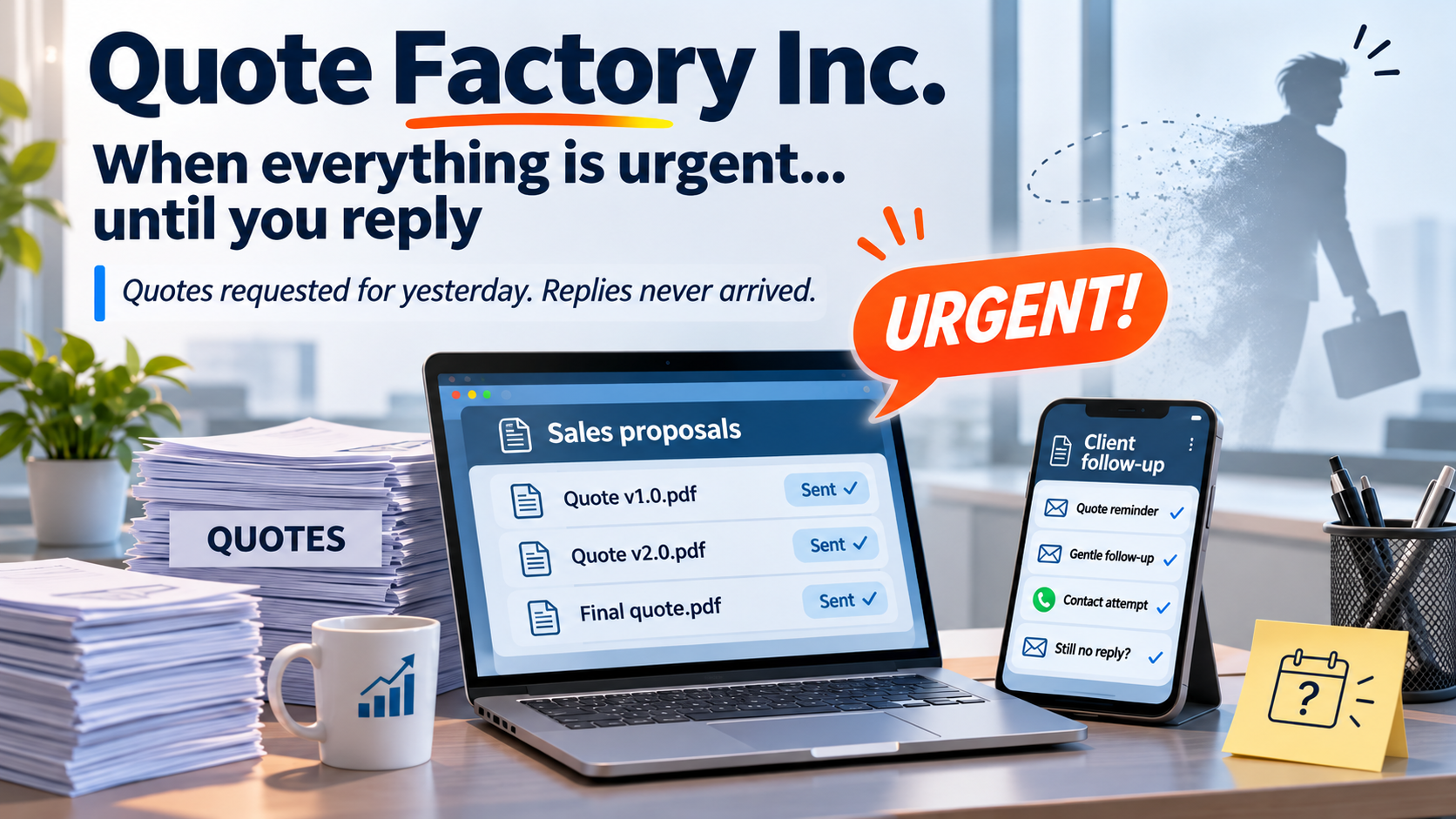
Semi-serious tales of last-minute requests, disappearing prospects, and businesses turning into free consulting machines.
“URGENT. Please contact me as soon as possible.”
The message arrives through the company website. The sales team springs into action. First phone call: no answer. Second call: nothing. WhatsApp: silence. Text message: ignored. Email: unanswered. LinkedIn: no signs of life. At this point, the only options left are carrier pigeons and smoke signals.
And yet, it was urgent.
Welcome to the wonderful world of on-again, off-again prospects: people who expect immediate attention when they need something but suddenly become unreachable when it’s their turn to respond.
Can You Send the Quote Tomorrow? Actually, Yesterday Would Be Better.
Then there’s an even more fascinating category. These are the people who contact you at 6:47 p.m. on a Friday, requesting a comprehensive proposal including strategy, analysis, activities, timelines, costs, and preferably a few innovative ideas.
“Could you send everything by tomorrow morning?”
Of course. Just cancel dinner, mobilize your colleagues, and forget about the weekend. The proposal goes out, complete with strategic recommendations and tailored solutions. And then?
Complete radio silence.
No questions. No objections. Not even a polite “Thank you, we’ve decided to go in a different direction.” Perhaps they’ll resurface six months later. Naturally, with another urgent request.
Welcome to the Quote Factory
Many businesses have unknowingly developed an entirely new line of business. They don’t just provide services, consulting, or solutions.
They manufacture proposals. For free.
Initial quotes, updated quotes, revised quotes, three different scenarios, five pricing options, and perhaps a complimentary mini marketing strategy thrown in for good measure. The problem isn’t losing a deal. That’s part of doing business. The problem is spending hours of skilled work on prospects who have no budget, no decision-making authority, or no genuine intention of buying.
Requesting multiple quotes is perfectly legitimate. Changing your mind is normal. But repeatedly consuming someone else’s time and expertise without even acknowledging their work is something else entirely.
The Five Species of Ghost Prospects
1. The Urgency Addict. Writes “URGENT!!!” in the contact form and then vanishes. Apparently, the urgency expired seconds after clicking Submit.
2. The Quote Collector. Collects proposals the way other people collect stamps. Every quote triggers a request for more details. The final decision remains a mystery.
3. The Free Consulting Enthusiast. Wants your strategy, benchmarks, and operational roadmap before making a decision. Once everything arrives, the project is handled internally or assigned elsewhere.
4. The Chronic Indecision-Maker. Needs to consult the business partner, the director, the finance department, and possibly their horoscope. The project will start next quarter. Which year? Nobody knows.
5. The Resurrection Specialist. Disappears for months, then suddenly returns with a cheerful: “Hi! Remember our project? Could you update your proposal by tomorrow?” Of course.
Not every disappearing prospect is a time-waster, however. Frozen budgets, changing priorities, and complicated decision-making processes can explain many unanswered messages.
Silence is a signal, not a diagnosis.
How to Avoid Becoming a Quote Factory
The solution isn’t to become suspicious of every prospect. It’s to build a smarter sales process. Here are five essential rules:
1. Qualify before quoting. What’s the objective? Is there a budget? Who makes the decision? What’s the timeline? Without this information, investing hours in a detailed proposal may be premature.
2. Separate quoting from consulting. An indicative price estimate can be free. An in-depth strategic analysis has professional value and may deserve a paid engagement.
3. Agree on the next step. Before sending the proposal, schedule a follow-up conversation. A prospect’s willingness to discuss the offer is already a useful signal of commitment.
4. Use your CRM properly. Track interactions, automate follow-ups, and distinguish genuine opportunities from inactive leads. Chasing someone indefinitely isn’t a sales strategy.
5. Learn to say no. Not every inquiry deserves the same investment. Sometimes declining to prepare a proposal means freeing up valuable time for a genuine opportunity.
How Much Does the Quote Factory Really Cost?
Let’s run a simple example. A company receives 40 quotation requests per month. Each proposal requires an average of three hours of work, including analysis, preparation, and follow-up.
That’s 120 hours every month.
At an internal time valuation of €70 per hour, that represents €8,400 per month, or more than €100,000 per year in sales-related work. This is an illustrative calculation, not an industry statistic. Some of that investment is normal and necessary for acquiring customers. But how many of those hours are spent on genuinely qualified opportunities? The right question isn’t how many proposals we produce, but how many turn into customers, at what profit margin, and at what customer acquisition cost.
Because even a supposedly free lead can become surprisingly expensive.
The Real Problem? Maybe It’s Us.
If we keep preparing complex proposals for everyone who fills out a contact form, without qualification, clear criteria, or a structured sales process, we can’t blame everything on prospects. We’re building the Quote Factory ourselves.
A business doesn’t become more efficient by producing more quotes. It becomes more efficient by identifying earlier which opportunities truly deserve its time and expertise. And perhaps, once in a while, by actually receiving a reply. Even something as simple as: “Thank you, we’ve decided to work with another supplier.”
It’s not a sale.
But it’s already a small step forward for business civilization.
What about you? What’s the most absurd quotation request you’ve ever received? Have you found an effective way to distinguish a genuine prospect from a professional quote collector?
Share your experience in the comments.
Preferably without writing “URGENT”.