When companies talk about CRM, many still think first about a software platform used to store contacts, sales opportunities, emails and sales activities.
That is only part of the picture.
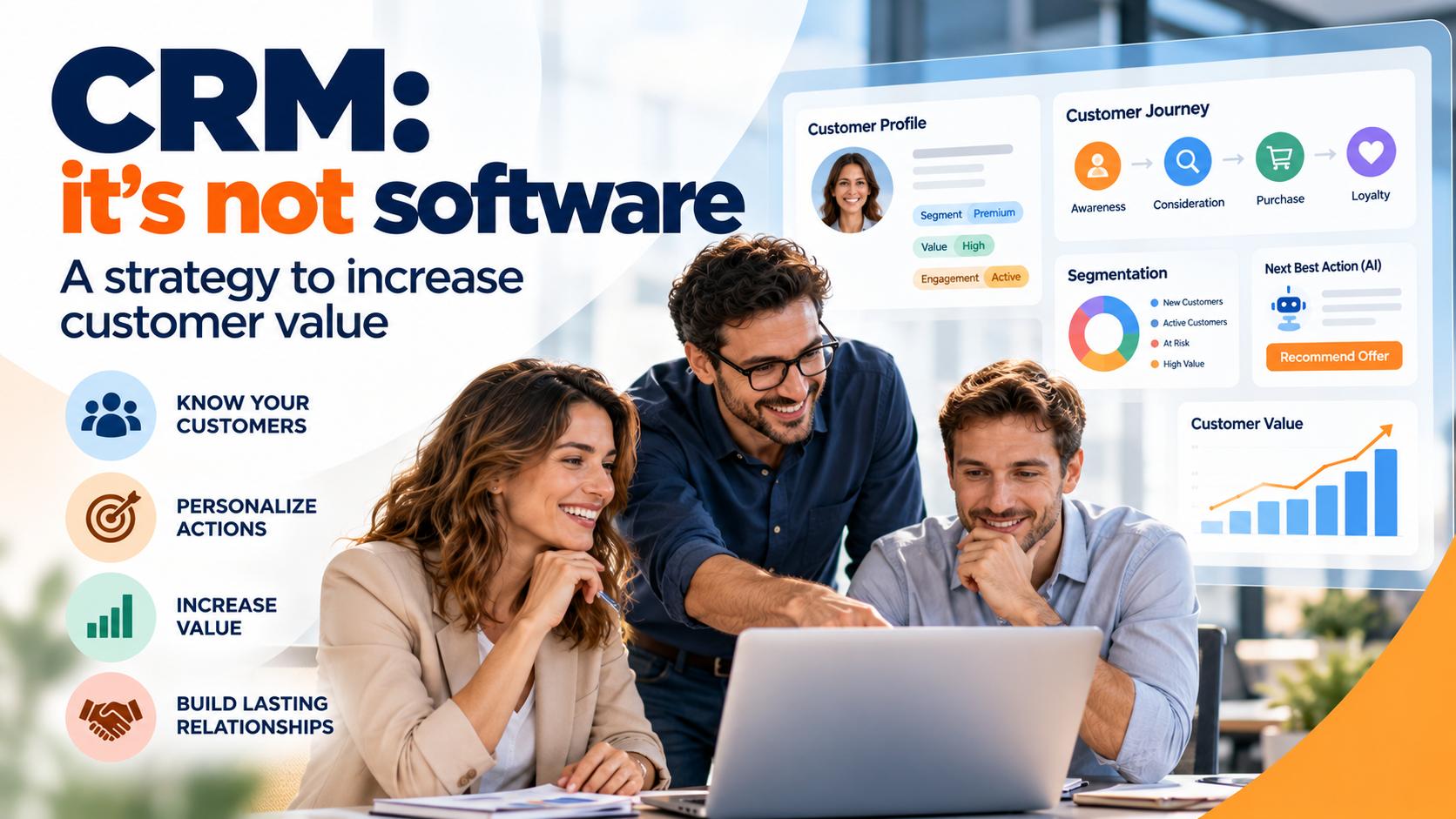
Customer Relationship Management is primarily a business strategy. It defines how a company understands its customers, which information it collects, how customers are segmented and which actions should be activated to increase the value of each relationship over time.
Technology enables this strategy. Without clear objectives, reliable data and shared processes, even the most sophisticated CRM platform can become little more than an expensive customer database.
From customer records to a single customer view
The first objective of an effective CRM strategy is to overcome data fragmentation.
The same customer may appear in an ERP system, an e-commerce platform, email marketing software, customer service tools and a loyalty programme, often with different or incomplete information.
Value emerges when these signals are brought together into a coherent customer view: what the customer purchased, when they interacted with the brand, which products or services they explored, which preferences they declared and how they responded to previous campaigns.
This is becoming even more important as artificial intelligence spreads across marketing organisations. Salesforce’s 2026 State of Marketing identifies fragmented systems and poor-quality customer data as major barriers to personalisation and effective AI adoption, while teams with better unified data are more able to use AI at scale.
Segmentation should go beyond demographics
Two customers of the same age living in the same city can have completely different relationships with a company.
One may purchase regularly while another bought only once. One may actively engage with communications while the other has been inactive for several months.
An advanced CRM strategy should therefore combine demographic information with purchase frequency, average value, recency, interests, preferred channels, behavioural signals and Customer Lifetime Value.
The question is no longer simply “Who is this customer?” but rather “What is this relationship worth, what might this customer need next and which action is most likely to create value?”
Turning customer data into action
The purpose of CRM is not to collect as much data as possible. Its purpose is to support better decisions.
A newly acquired customer may enter an onboarding journey. A high-value customer may receive differentiated loyalty benefits. An inactive customer can be targeted with a reactivation programme. A prospect showing strong intent can be prioritised and quickly transferred to the sales team.
The same principle applies to cross-selling and upselling. Recommendations should result from an understanding of the customer relationship rather than sending the same proposition to the entire database.
CRM therefore becomes a connection point between customer acquisition, marketing, sales, customer service and loyalty.
Measure customer value, not only campaigns
A strategic approach to CRM also changes the way performance is measured.
Open rates, clicks and database size are useful operational metrics, but they do not describe the economic quality of a customer relationship.
Companies should also monitor conversion, purchase frequency, retention, churn, average customer value, profitability and Customer Lifetime Value.
This can completely change the evaluation of acquisition channels.
A source generating customers at a higher initial acquisition cost may still be more profitable if those customers stay longer, purchase more frequently and generate higher margins.
CRM therefore helps connect Customer Acquisition Cost with Customer Lifetime Value, moving the organisation beyond individual campaign performance.
AI and CRM: data comes before automation
Artificial intelligence can significantly increase the potential of CRM.
Lead scoring, churn prediction, personalised recommendations, cross-selling and Next Best Action are increasingly accessible applications.
But AI cannot automatically fix poor customer data or badly designed processes.
Automating inaccurate information simply allows mistakes to happen faster.
Before scaling AI, companies need consistent data structures, governance rules, correctly managed permissions and clear commercial objectives.
From CRM to customer value management
The first question should therefore not be: “Which CRM software should we buy?”
A better question is: “Which customer relationships do we want to develop, which behaviours do we want to encourage and what information do we need to make better decisions?”
That is when CRM becomes a genuine business strategy.
CWMedia supports companies in developing Marketing, CRM and customer value strategies, from customer database segmentation and journey design to the integration of acquisition, loyalty, gamification and marketing automation initiatives.
Because knowing customers better is only the beginning. The real objective is to turn that knowledge into more relevant relationships and greater long-term customer value.